Go Soft, Get Happy
I like IGV and CSU. Maybe even SAP!

Sometimes the stock market resembles a young golden retriever let loose in a field of rabbit burrows. Great excitement, but capricious.
The current market has something of that energy. This year’s motto, until around late-April: “Chips are A.I., so buy semiconductors. Meanwhile, A.I. kills software, so sell software”.
Hence, this year, the Semiconductor ETF SMH has gained 40% (to end-April), while the software ETF (IGV) lost -20.61%.
Since this month however, I’ve been noticing a different narrative: “There is actually little evidence that Chat GPT et al will comprehensively automate software development. On the other hand, software companies are actually able to utilize A.I. very well.”
It’s time for a resurgence of Software, it seems. The most seriously bombed-out stocks are now making higher lows and higher highs. So by now, I think the risk-reward ratio looks pretty good.
Constellation Software was for years a corporation that could do nothing wrong. Their business model was simple: buy the best small software companies; integrate and optimize their processes, wash and repeat.
Look at this chart from 2009 to 2025. Their price per share started at 20 and rose to 4400: In other words, by approximately 22,000% in 16 years, which is equivalent to a CAGR of over 35%.
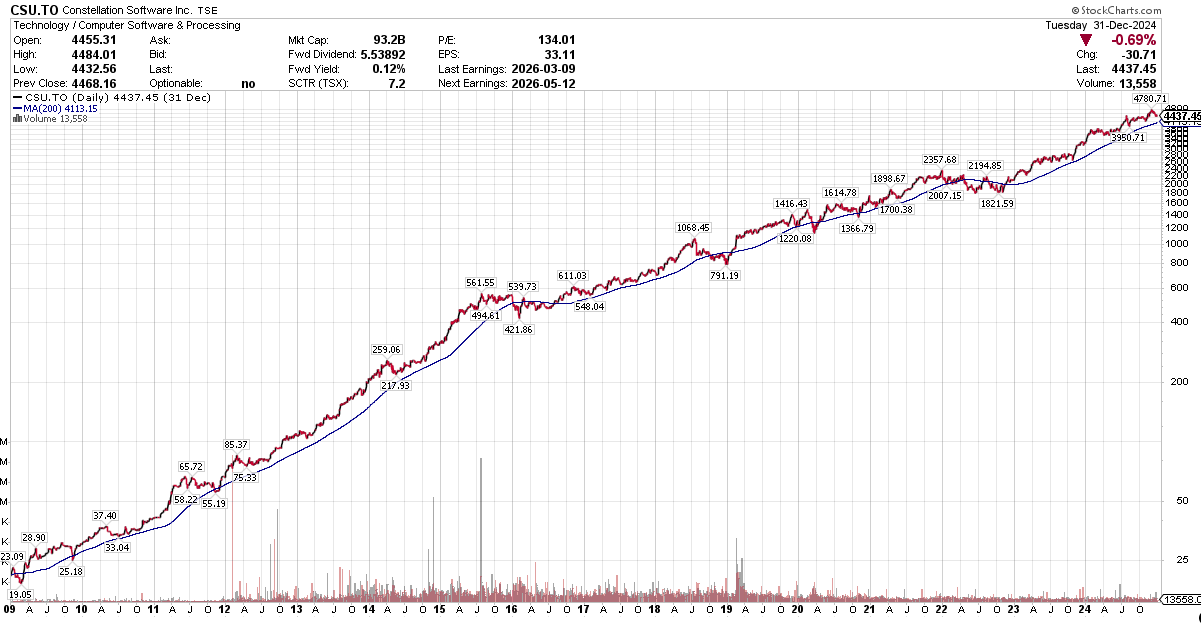
The trend was most certainly your friend with CSU, until (as always) the bend in the end. Since 2025, the stock has lost over 50% of its value.
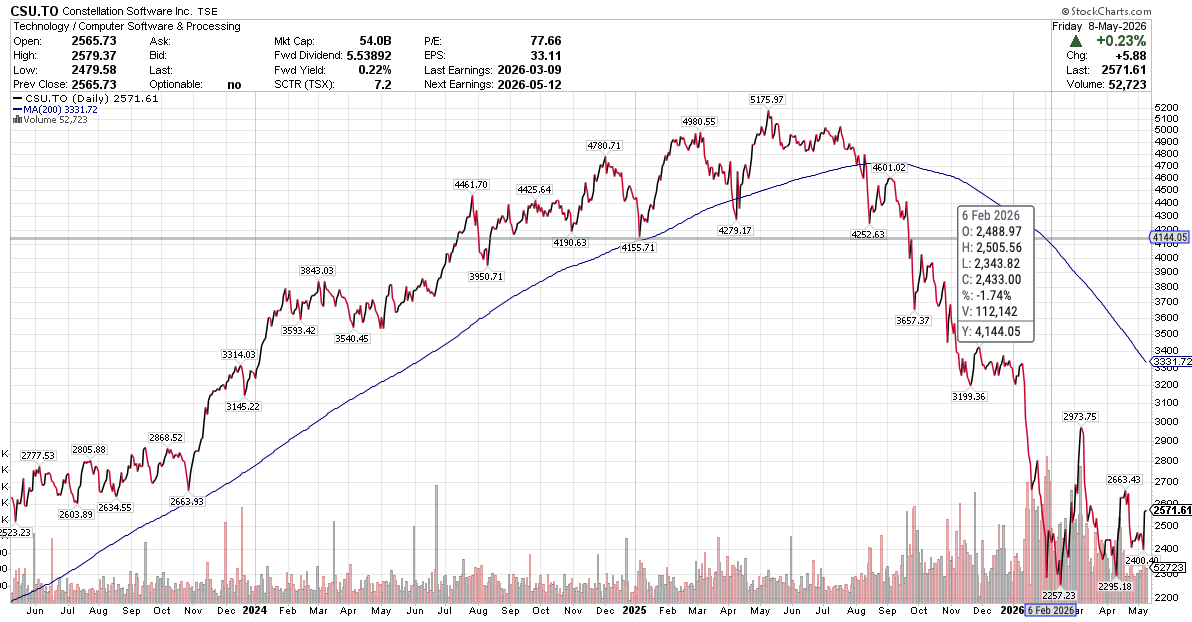
So, just to put this in one incredible sentence, if you bought Constellation, you’d be getting a company that generally compounds with 35%, but at a current discount of 50%. I very well may be wrong, but this has the inklings of a generational deal.
I’m certainly calling baloney on the idea that in the future, we won’t need any proper, professional software anymore.
But as always, I like to rely less on my beliefs, and prefer a rule-based system. It’s not enough to generally be right; you have to get the timing right too.
Investing in IGV, the iShares software ETF, has worked out pretty well if you observe my indicator of choice of the market’s animal spirits — namely, the price of Bitcoin. If you only bought IGV whenever the price of Bitcoin was above its 100-day exponential moving average, from 2012 onwards (until end-April 2026) you would have attained a CAGR of 14.34%, with a maximum monthly drawdown of -12.28%.
For European investors, I’d suggest a closer look at the world’s largest vendor of enterprise software, Germany’s SAP. Their returns haven’t been as juicy as CSU’s — only growing by around 1,200% from 2009 to 2025, equivalent to a CAGR of +12.82% for the buy-and-hold crew.
Again, using Bitcoin as your buy/sell indicator, your risk/reward ratio improves, and you get a CAGR of +16.4%, maximum monthly drawdown of -35.44%, with a worst year clocking in at -5.48%.
Do you really think this major corporation will just suffer from A.I, and not at all benefit?
I’m highly interested in your thoughts.
++++++++++++++++++++++++
ADDENDUM May 11: A kind reader wrote to me directly, saying,
“If you buy individual names, you might like fintech $PAR too. Restaurant POS software with a CEO that understands capital allocation.
I don’t think AI eats software, to the contrary I think the best software companies are the earliest beneficiaries of the decreasing cost of code. And everything that enables more online business should benefit; from cloud providers like Cloudflare to financial infrastructure like Wise, Adyen etc.”
PAR is indeed intriguing! Down almost to March 2020 levels, around 80% lower than its all-time high.
Excellent article, as always. I do have one comment: Constellation averages too few shares per day for me, but PAR has very good potential. Thanks!
Thanks Martin.